
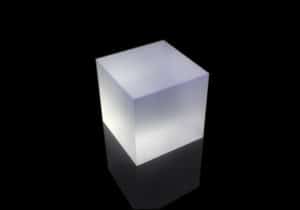
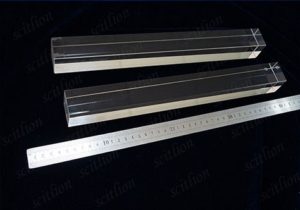
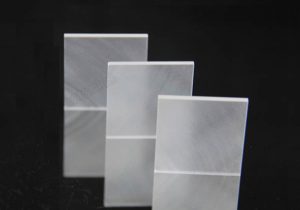
CaF2(Eu) Scintillator (CaF2(Eu) Scintillation Crystal)
Calcium fluoride doped with europium (CaF₂:Eu) is a well-established inorganic scintillation crystal prized for its chemical stability, non-hygroscopic nature, and mechanical robustness. Under ionizing radiation, it exhibits intense blue luminescence centered around 420–435 nm, originating from the 5d–4f transition of Eu²⁺ ions, with a high light yield of approximately 19,000 photons/MeV and a fast decay time near 0.94 μs. Its low effective atomic number and minimal backscattering make it particularly suitable for beta-particle detection, low-energy gamma-ray spectroscopy, and specialized applications such as tritium monitoring and dark matter searches.
OST Photonics supplies high-quality CaF₂(Eu) crystals in various dimensions and specifications upon request, ensuring a precise match for your specific application.
Application
Low-level Tritium Detection
Compton Camera Scattering Plane
Astrophysics Dark Matter Search
D-D Neutron Active Interrogation
Environmental Radiation Monitoring
Features
High Light Yield
Low Material Density
Excellent Environmental Stability
Low Effective Atomic Number
Pulse Shape Discrimination Capability
Production and Supply Capability
Maximum Size: ɸ80mm x 120mm
Available items: monolithic crystal
Properties
Density [g/cm3] | 3.18 |
Melting point [K] | 1691 |
Thermal expansion coefficient [C-1] | 19.5 x 10⁻⁶ |
Cleavage plane | <111> |
Hardness (Mho) | 4 |
Hygroscopic | no |
Wavelength of emission max. [nm] | 435 |
Lower wavelength cutoff [nm] | 395 |
Refractive index @ emission max | 1.47 |
Primary decay time [ns] | 940 |
Light yield [photons/keVγ] | 19 |
Photoelectron yield [% of NaI(Tl)] (for γ-rays) | 50 |