
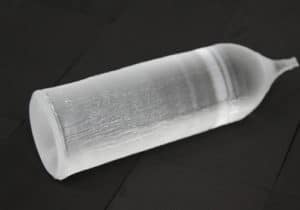
LYSO(Ce) Scintillator (LYSO(Ce) Scintillation Crystal)
Cerium-doped Lutetium-Yttrium Oxyorthosilicate (LYSO:Ce) is a high-performance inorganic rare-earth scintillation crystal. It features a high density of ~7.4 g/cm³, fast decay time of less than 44 ns, and a light yield of ~32,000 photons per MeV, with excellent chemical stability and no hygroscopicity. It is the most widely used scintillation material for modern PET scanners, also applied in high-energy physics and nuclear radiation detection.
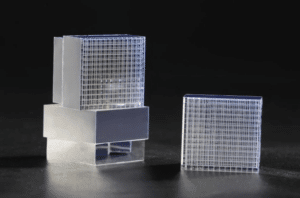
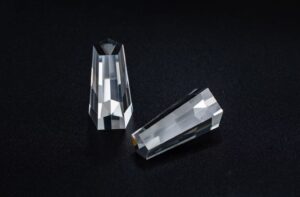
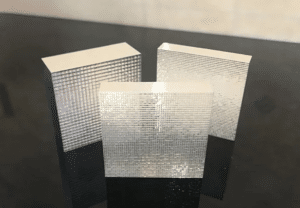
OST Photonics owns a complete crystal processing and assembly production line, and can customize all types of LYSO(Ce) crystals and LYSO(Ce) arrays in full compliance with your specific requirements.
Application
Time-of-Flight Positron Emission Tomography (TOF-PET)
High Energy Physics Experiments
Gamma-ray Spectroscopy
Nuclear Homeland Security
Features
Excellent Overall Performance: Combines a high density of 7.4 g/cm³, fast decay time of less than 44 ns, and high light yield of ~32,000 photons/MeV
Excellent Physical Stability: Non-hygroscopic, chemically inert and mechanically robust,
Mature Large-size Growth
High Radiation Hardness
Production and Supply Capability
Maximum Size: ɸ105mm x 200mm
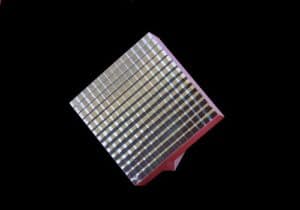
Available items: monolithic crystal, scintillation screen, pixellated array
Scintillation Screen Design Options of LYSO(Ce) Scintillators
Freestanding ultra-thin scintillation screen.
Ultra-thin scintillation screens can be coupled to a substrate with optical adhesives in order to achieve better optical readout.
Scintillation screens can be inserted into frames(Aluminum, Stainless steel) for easier manipulation.
We can provide customized marking such as a grid, cross or scale on the surface of the screen for easier beam visualization.
We can provide various coating on the surface of the screen upon request, such as reflection coatings(Al, Au, Ag, etc.), AR coating, diffusion painting(TiO2, Al2O3), and conductive coatings(Al, ITO, C).
Properties
Density (g/cm3) | 7.4 |
Radiation Length (cm) | 1.10 |
Effective Atomic Number | 66 |
Decay Constant (ns) | 40-44 |
Light Yield (Relative BGO=100%) | 190 |
Index of Refraction | 1.82 |
Wavelength of Max Emission (nm) | 420 |
Radiation Hardness (rad) | >10^8 |
Melting Point (°C) | 2050 |
Hardness (Mohs) | 5.8 |
Cleavage | None |
Hygroscopicity | No |